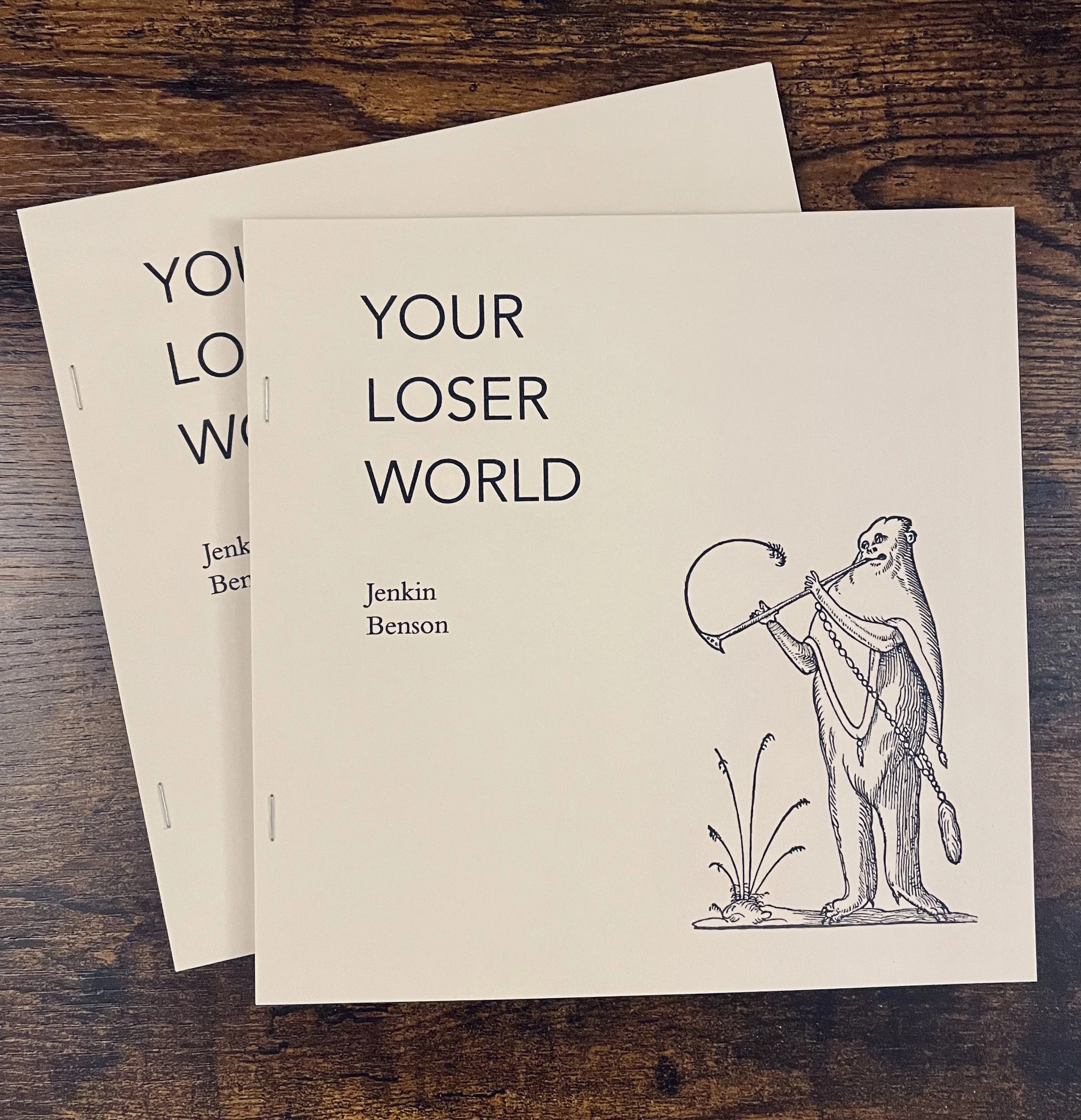
An interview with Jenkin Benson about his new book, Your Loser World, available now from Dead Mall Press
On June 16th, Dead Mall Press released Jenkin Benson’s Your Loser World, a full-length collection that feels less like “poetry” and more like “jolts of linguistic disintegration”—and is all the better for it. As I write this, copies are making their way through the mail to new readers, and you can secure your own via this very website.
Also, every sale will help us raise $3 for the Haitian Support Center in Springfield, Ohio, which provides much-needed aid to the Haitian immigrant community in that city (which is very near the press’s Dayton home). And as if that were not enough, each order comes with bonuses such as one-of-a-kind bookmarks and a DMP sticker. Act now, dear reader, while supplies last.
Recently, Jenkin and I discussed his work, you can read the email convo below. Also, there are a few sample poems appended at the end. Enjoy!
Dead Mall Press: Hey, Jenkin! Thanks for agreeing to this interview. For those who may be unfamiliar with you and your work, could you tell us a bit about yourself and your path as a writer?
Jenkin Benson: Greetings greetings! I’m Jenkin Benson. I’m originally from rural central Iowa, about 25 miles outside of Des Moines. I lived a couple years in Vancouver, British Columbia. And now I’m a PhD candidate in South Bend, Indiana. I study Global Anglophone literature, mostly the relationship between Celtic modernism and contemporary Caribbean poetry. And when I’m not dissertating, I’m writing these wacky, wacky poems.
DMP: So tell us about Your Loser World. While I worked on this book, that title really developed in my mind and took on more resonance.
JB: This project emerged from material I was reading in Dr. Matt Kilbane’s “Lyric Theory and the Poetic Archive” grad seminar. I’m directly responding to The Pisan Cantos. Honestly, the name is me clowning on high modernism. Eliot, Jones, Pound, etc, so many of those figures spent the first half of the 20th century bemoaning the horror and decadence of modern capitalism, all the while gleefully supporting ideologies and theologies that either directly cultivated capital, or were instated by capital. Your Loser World is our loser world, and it’s actually the world that many of the canonical modernists who precede us wanted, whether they understood that they wanted it or not. Here you go Ezra; you got what you got. Eat up. It’s doggggggsssssshit.
DMP: Your style in this book, and elsewhere, is highly individual. It strains the limits of English, verging into non-words, and the use of form—while inventive and wide-ranging—also sometimes feels like anti-form. But the overall effect is often intensely musical. Can you talk about how this style developed?
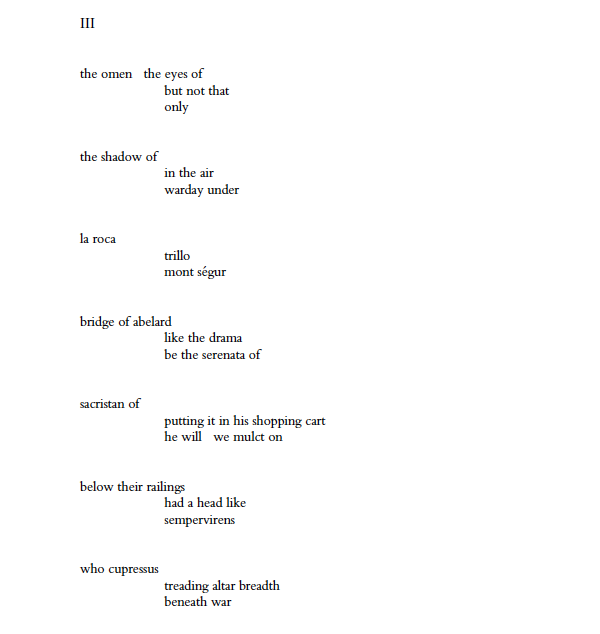
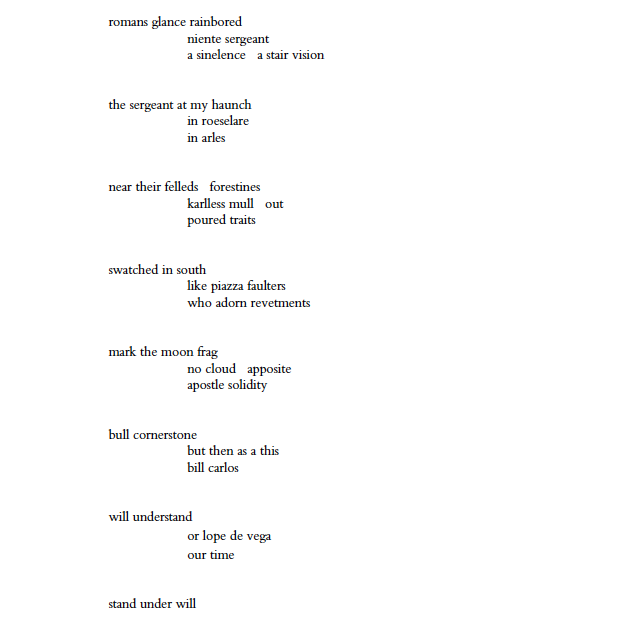
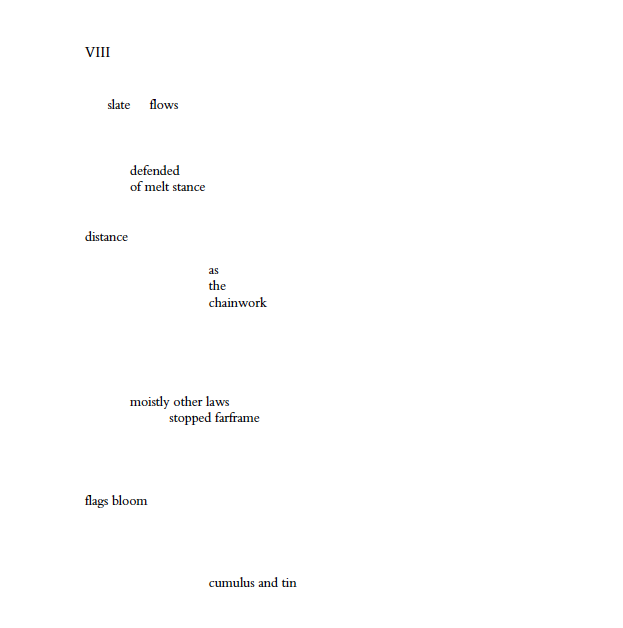
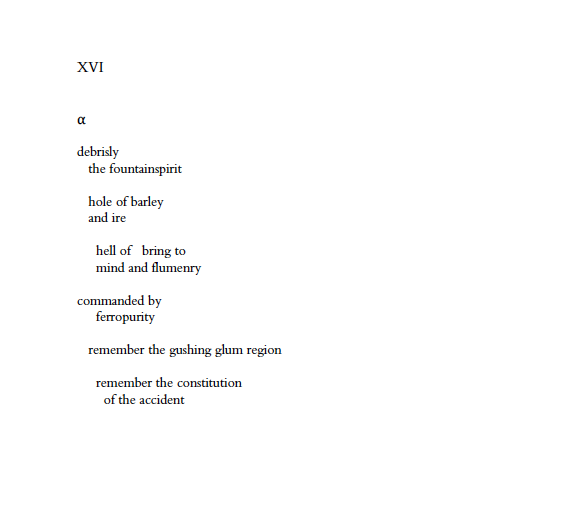
JB: According to my gravimetric analyses, Your Loser World is a collection of vandalized cantos. The initiatory strategy of the text was taking large chunks of The Pisan Cantos, then totally jumbling and rearranging the words. After that, I would mangle the wordbank even further by substituting prefixes and suffixes with alternates. I would transposition and transfigure roots too. I put slices of words through digital translators (english to x to y to z to english) to try and estrange them even more. Once these keywords had undergone several mutations, that’s when I began picking and choosing and chiseling—just playing around with the text on the page—til I started to observe these defacements becoming cantos. I suppose I crafted some phylum of surreal, wonky, graffiti? For an exacting time: call Your Loser World.
DMP: As a musician, do you find your practice as a poet is an extension of the same artistic impulses, or is there more of a separation between them?
JB: I listen to a lot of jazz and heavy music, a lot of free jazz and mathcore specifically. Unfortunately, I’m not that good at guitar, so I can’t really make jazz or technical heavy music that well. So, I compromise with myself. Much of the music I make relies on conventional pop song structures, but I’ll use weird time signatures: maybe the verse is in 9/8 and maybe the chorus is in 14/4. A lot of my poetry adheres to an akin approach. I’ll use an anti-iambic blank verse, or the undergirding of ballad meter, but I try to render the language into a form that has no need for post-confessional, epiphanic, lyri-romantic, outpouring. I am definitely very incited by the challenge of polymerizing the traditional and the distinctly counter-traditional.
All that typed, Your Loser World is very much unlike the other manuscripts I’m currently deliberating on. I let myself just scribe the words down. It was, I think, my most improvisatory writing process, the closest I can get to making art like Grachan Moncur III or Psyopus.
DMP: This book contains two epigraphs. The first comes from Adorno’s Minima Moralia, and it reads: “The Fascist regimes of the first half of the 20th century have absurdly stabilized an obsolete economic form, multiplying the terror and misery the latter required for its continued preservation, now that its senselessness is plain as day.” I find the complex of absurdity, terror, misery, and senselessness to be a fitting background ambience for the poems. I wonder if you could speak a bit about your selection of this quote.
JB: Settler colonialism and the fascist proxies it begot won WWII and the Cold War. A vast majority of Americans have been fine with this political reality because beef and electronics were cheap for a good several decades. Now we live in this lich polity where the body is festering, but it’s still inflicting unfathomable violence upon the subaltern. The below tweet offers a basic encapsulation of what I’m describing here:

There’s this stale poetry truism I see a lot online that goes something like: “Poetry says what cannot be said.” I have zero interest in that. I want my work to disarticulate said terror and misery.
DMP: Along these lines, the second epigraph—coming from the letters of Edward Dorn and Amiri Baraka—reads: “& don’t please give me that shit about 150 ‘ideal’ readers— Fuck Literature.” That pretty much says it, but for the sake of discussion, how do you understand the project of “literature” as it stands at present?
JB: My more robust response: From about 2017 to the end of 2022, I didn’t write that much. In retrospect, I was frustrated that I was unable to reverse engineer and/or regurgitate the contrivances of prestige lyric poetry. I was unable to craft the subtle plagiarisms of celebrated 20th centuryists—mostly Heaney it seems—that supposedly correct lyricism galaly requires. Eventually I realized that I wanted to write how I could write and I didn’t want to generate facsimiles of forms beloved by people I don’t rock with.
My tbh response: Why would I write poems designed to please award/prize judges who have never listened to Max Roach/Anthony Braxton, who have never listened to Fire Party, who have never listened to Black Noi$e? “Fuck literature” fr these people do not like good things.
DMP: Lastly, what do you hope that readers take away from reading this book? What kind of energy and/or vision do you hope it puts into the world of its readers?
Every day, we are told by officials—financiers, legislators, insurance reps, various institutional admins, editors, and people who simply do not have the juice—that what we’re doing/what we desire “isn’t feasible” or “won’t work.”
And actually, no, it will work. We will will it to work.
The words will be however we want them to be. The violences will stop. We’ll get the closest we can to utopia before it gets too hot for grain to grow. That’s how shit is gonna go.
Also, everyone get more mass strike immediately.
jenkin benson is a poet, scholar, and musician. his books and chapbooks have been published by cutt press, new mundo press, stone corpse press, and chameleon's. he is from iowa.
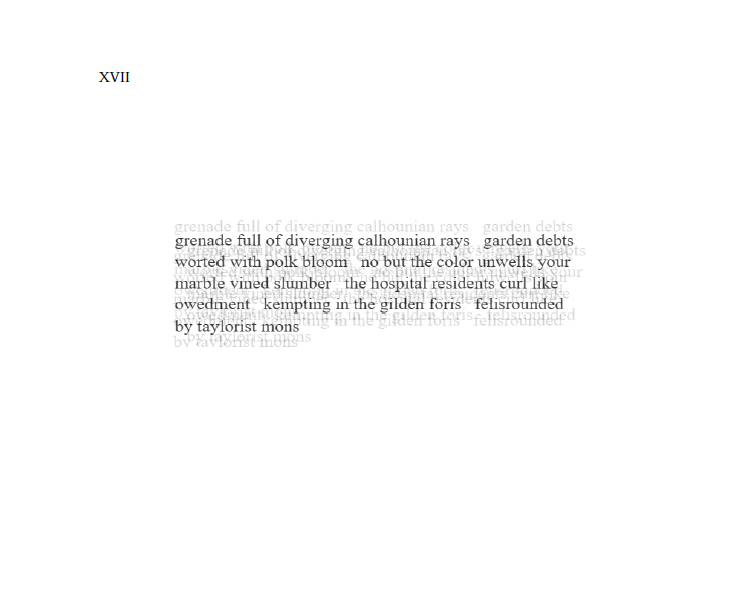
You can order Your Loser World here. To further prime your interest, here are a few sample poems. Click on each image to expand: